Sustainability research is full of intelligence, commitment, and technical brilliance - yet it continues to circle the same patterns, producing insights that rarely shift the deeper trajectory of our systems. We refine our models, expand our datasets, and optimise our interventions, but something essential remains untouched. The crises intensify, and our methods become more sophisticated without becoming more transformative.
At moments like this, progress doesn’t come from adding more tools. It comes from turning the frame itself upside down.
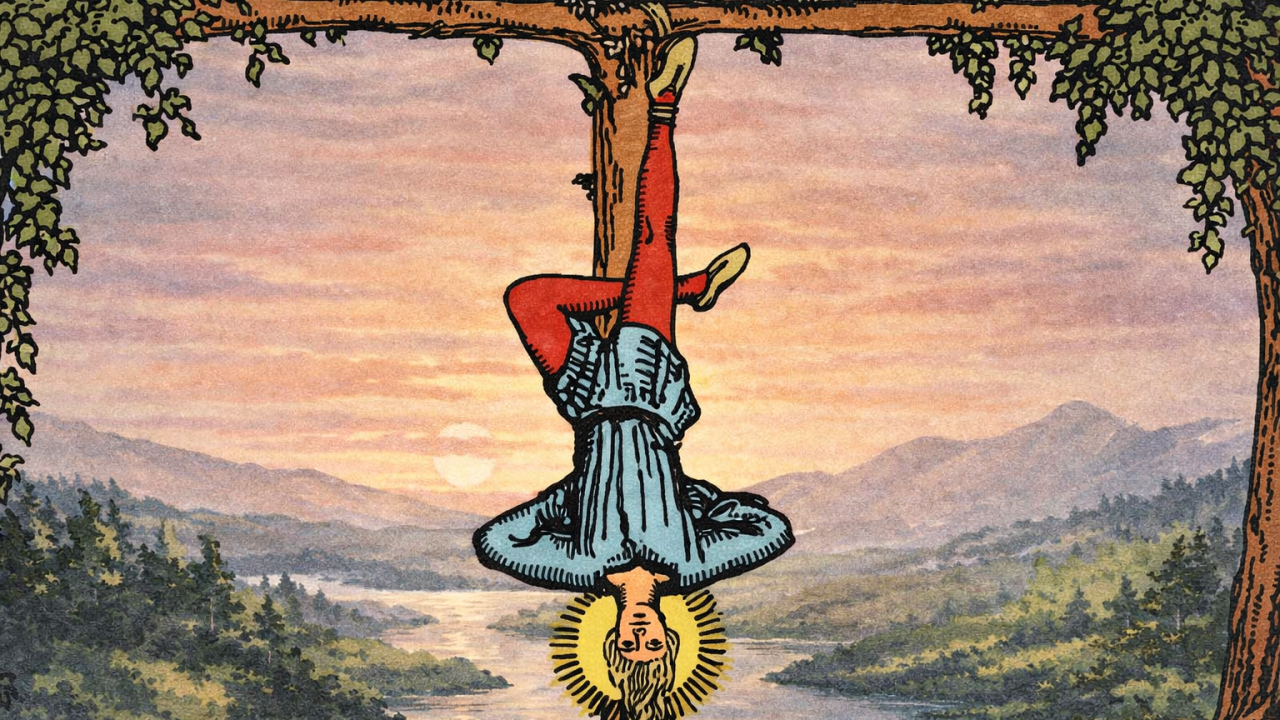
The Hanged Man - a figure suspended calmly, willingly, and without struggle - offers a symbol for a kind of seeing that our field has almost forgotten. Not a mystical gesture, but a cognitive one: the deliberate suspension of the worldview that places the observer outside the system, the mind above the world, and knowledge as something extracted rather than participated in.
This article explores what happens when we allow that inversion.
When we pause long enough for the familiar ground to loosen.When we let the world reveal itself from a different vantage point.
Not as a metaphor, but as a method.
And at the end, a simple koan - a turning phrase - invites the reader into the same shift. Not to explain the inversion, but to enact it.
The Hanged Man - Why Sustainability Research Needs to Be Turned Upside Down
Most fields evolve by adding new tools, new data, new methods. Sustainability research is different. Its challenge is not a lack of tools but a surplus of assumptions - assumptions inherited from a worldview that sees the world as an object “out there” to be studied, modelled, and fixed.
This worldview is so normal, so invisible, that we rarely question it. But the crises we face are not technical problems. They are epistemic problems. They arise from the way we see the world, not just the way we act in it.
And this is where an unexpected guide steps forward: the Hanged Man of the Tarot.
The Hanged Man as the Missing Phase of Sustainability Research
The Hanged Man hangs upside down not because he is trapped, but because he has chosen to suspend the habitual way of seeing. He represents:
- inversion
- surrender
- suspension
- the pause before insight
- the dissolution of the observer–observed split
In systems language, he is the archetype of epistemic reframing. In Theory U language, he is the descent into letting go. In cognitive language, he is the moment when the frame becomes visible.
Sustainability research rarely enters this phase. We rush from analysis to solutions, from data to interventions, from models to policy. We optimise, predict, quantify, and control - all while standing on the same conceptual ground that produced the crisis.
The Hanged Man invites us to do something radically different: to stop, invert the frame, and see with new eyes.
The Inversion That Explains All Others
Every sustainability failure can be traced back to one core assumption:
Mind emerges from matter. The world is “out there”. The researcher stands outside the system.
This assumption is so deeply embedded in modernity that it feels like common sense. But it is precisely this stance - the stance of separation - that makes genuine transformation impossible.
The Hanged Man offers the counter‑move:
Matter appears within mind. Experience is primary. The observer is part of the system they observe.
This is not mysticism. It is phenomenology, complexity theory, systems theory and quantum theory. It is systems thinking at its most honest. It is the recognition that the world we study is always co‑arising with the mind that studies it.
Once this inversion is seen, everything else follows:
- From control - to participation
- From prediction - to relationship
- From intervention - to co‑evolution
- From objectivity - to embeddedness
- From technical solutions - to transformations of consciousness
This is the Hanged Man’s gift: the world becomes coherent only when the self–world boundary dissolves.
Why Sustainability Research Must Hang Upside Down
Because the crises we face are not external problems. They are reflections of the worldview that created them.
We do not need more models. We need a different vantage point.
We do not need more data. We need to see the data from within the living system.
We do not need more urgency. We need the courage to pause long enough for the old frame to loosen its grip.
The Hanged Man is not passive. He is performing the most radical act available to a researcher: suspending the worldview that makes the problem unsolvable.
The Koan That Turns the World Upside Down
And so the piece ends where the inversion begins - not with an argument, but with a koan. A line that does not explain but undoes. A line that places the reader in the same suspended state as the Hanged Man.
When mind creates matter, we study the world. When matter appears in mind, the world studies us.
This is the turning. This is the inversion. This is the doorway to seeing with new eyes.